
Back to Fish Guide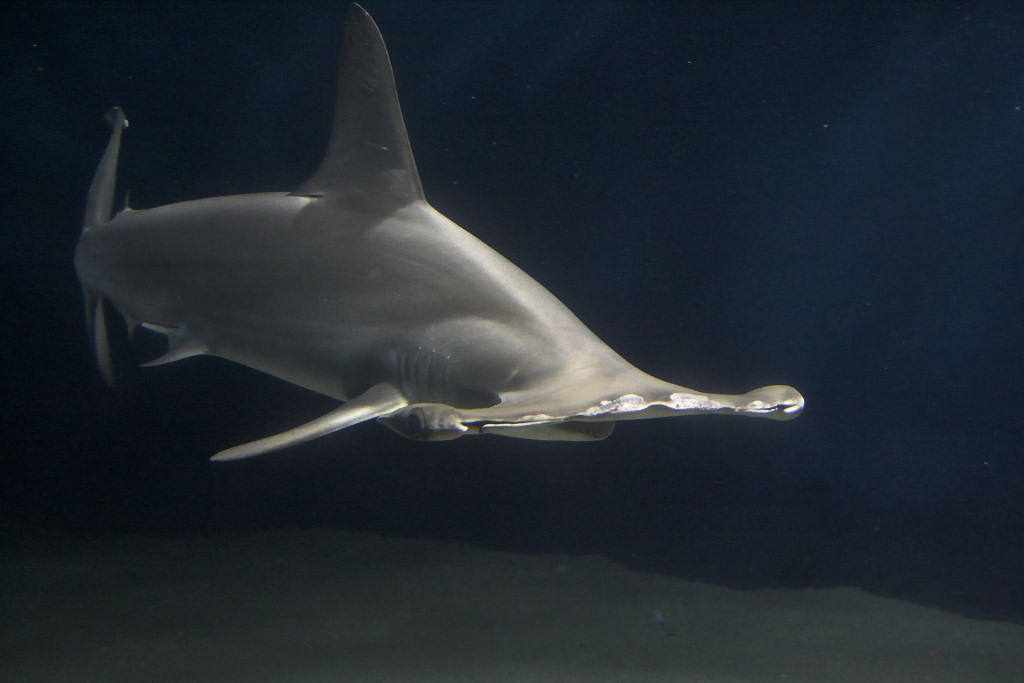 Shark
suneko · CC BY 2.0 · via Wikimedia Commons · https://commons.wikimedia.org/wiki/File:Hammerhead_shark.jpg
Hammerhead Shark
Sphyrna lewini
About this fish
Description▾
The Scalloped Hammerhead is a large shark of the family Sphyrnidae, instantly recognisable by its laterally expanded, hammer-shaped head (cephalofoil) with a distinctive scalloped front margin. The body is grey-bronze above and white below, with a streamlined build capable of sustained swimming. Found in warm-temperate and tropical waters worldwide, it is one of the most widely distributed hammerhead species, often forming large schools around seamounts.
Identification▾
Unmistakable due to the laterally flattened head with its wide, T-shaped profile and scalloped front edge with a prominent central indentation. Distinguished from the Great Hammerhead (Sphyrna mokarran) by its scalloped head margin (the Great Hammerhead has a nearly straight front edge) and its generally smaller adult size. The Smooth Hammerhead lacks the central scallop indentation entirely.
Habitat▾
In PNG waters, Scalloped Hammerheads are found along deep outer reef walls, around seamounts, and near continental shelf edges. They often form schools at cleaning stations on deeper reef pinnacles during the day, dispersing to hunt at night. Juveniles use shallower coastal bays and lagoons as nursery areas. Encountered at depths from the surface to over 300 metres.
Best season & conditions▾
Encountered year-round in PNG, with schooling behaviour more commonly observed during the cooler months from May to September around deep pinnacles. Night fishing near reef passes during strong tidal exchanges can produce encounters. New and full moon periods with increased current seem to concentrate schools around deepwater structure.
Techniques, baits & lures▾
Most commonly caught incidentally while bottom fishing or live baiting near deep reef structure. Targeted fishing uses large live baits (mackerel, trevally) drifted near deep reef walls on heavy wire trace. Heavy tackle of 50-80lb class with 300lb wire leader is recommended. They fight with long, powerful runs and should be handled with extreme caution.
Size range▾
Commonly encountered at 150-250 cm total length and 30-80 kg in PNG. Maximum recorded size is approximately 430 cm and over 150 kg, though individuals above 3 metres are increasingly rare.
Handling & conservation▾
Listed as Critically Endangered by the IUCN due to severe global population declines from fishing pressure, particularly for the shark fin trade. If caught incidentally, release immediately with minimal handling. Cut the wire trace close to the mouth if the hook cannot be safely removed. Do not target this species deliberately.
AI-generated guidance. Verify details with experienced anglers before relying on it.